
 Analysts interpreting results from the U.S. Presidential election just over a month ago formed an overwhelming consensus that the United States is a divided nation. The Close results for Biden (51.4%} vs. Trump’s (46.9%) was the major indicator. The diversity skews were even more of a stark indicator. A majority of Whites voted for Trump (57%), while People of Color, overwhelming voted for Biden (72%). The increased gender divide, as predicted by pundits, didn’t bear out. In fact, White women (55%) and White men (58%), were close in their majority votes for Trump. Seniors, who pundits also predicted would shift to Biden didn’t’; they had the same 55% for Trump as in 2016. Younger and first-time white voters voted for Trump (43%), while Multicultural, in this segment, voted for Biden (86%). There was an inverse relationship between White evangelicals, (80%) voting for Trump vs. Black evangelicals (90%) voting for Biden.
This current national divide did not escape corporate America. What’s clear to corporate leaders and diversity practitioners is that a divided workplace cannot stand. It is reasonable to assume, these voting patterns represent their employees’ values, alliances and the issues most important to them. Understandably, many are on eggshells regarding how this “divide” will show up in their workplaces and affect day-to-day, 1:1 and team, workplace dynamics. For businesses to be successful, they must have their diverse employees operating as highly engaged individuals and inclusive teams focused on delivering the organizational mission and business imperatives.
Historical precedents have taught us lessons regarding how we’ve navigated a “divided nation”. The first recording, of this divided nation, is reflected in the famous quote by President Abraham Lincoln in 1858, “A house divided against itself, cannot stand”. Slavery was the dividing issue. Lincoln was referencing how slavery would destroy America’s democracy and his belief that the US democracy couldn’t survive with ongoing compromises allowing both half slave and half freed states in the new territories. Today, as a nation and business community, we are still enslaved with unresolved issues of race. We are confronting systemic racism, as the country is struggling with its “racial reckoning”.
Many contend this, current, racial reckoning has been an active process since 2017. Corporate America stepped up in a major way after the 2016 Presidential election to address the ensuing racial strife that came out of the shadows in 2017 until now.
There have been innumerable instances of racial strife and violence that have contributed to the sense of racial and social division that are representative of a “house divided”. Some specific instances are:
- Charlottesville, VA march of White supremacist
- The massacre of Black church members, while at a prayer service at the Emmanuel AME Church in South Carolina
- The rise in Race hostilities and Hates crimes
- The proliferation of White Supremacist groups, in counter-protests
- The summer BLM protests against the killing of unarmed Blacks by Police.
What’s clear is that to counter the “divided nation” narrative we have to entertain different perspectives on race and cultural issues and create brave spaces for people to share their points of view. The benefits can be tremendous when this occurs. For example, for the first time in June/July 2020, there was a positive shift in White America’s understanding of the “why”, regarding the Black Lives Matter Movement. White America wanted to engage in candid conversations about race and often reached out to their Black and Brown friends and associates to talk. Corporate America started publicly calling our race, systemic and structural racism and committed over $8+ billion to address issues of inequality and racism over the next 5 years.
One approach that has proven impactful was the 2017 launch of structured, “Meaningful Conversations” about Unconscious Bias, in which over 1200 CEOS, thru the CEO in Action Initiative, committed their companies to participate. Since June 2020, after the unfortunate murders of George Floyd, Breonna Taylor, and Ahmaud Arbery these conversations have morphed into discussions about race and their pace has accelerated.
After tens of thousands of these Meaningful Conversations, the needle is moving, regarding increasing racial understanding between people in their workplaces. In one of my company, Alignment Strategies, interventions our client’s senior to middle managers felt that engaging in Meaningful Conversations was a game-changer. Thus, the recommendation is that Corporate America stays the course and expand its Meaningful Conversations to address this current “Divided House” reality.
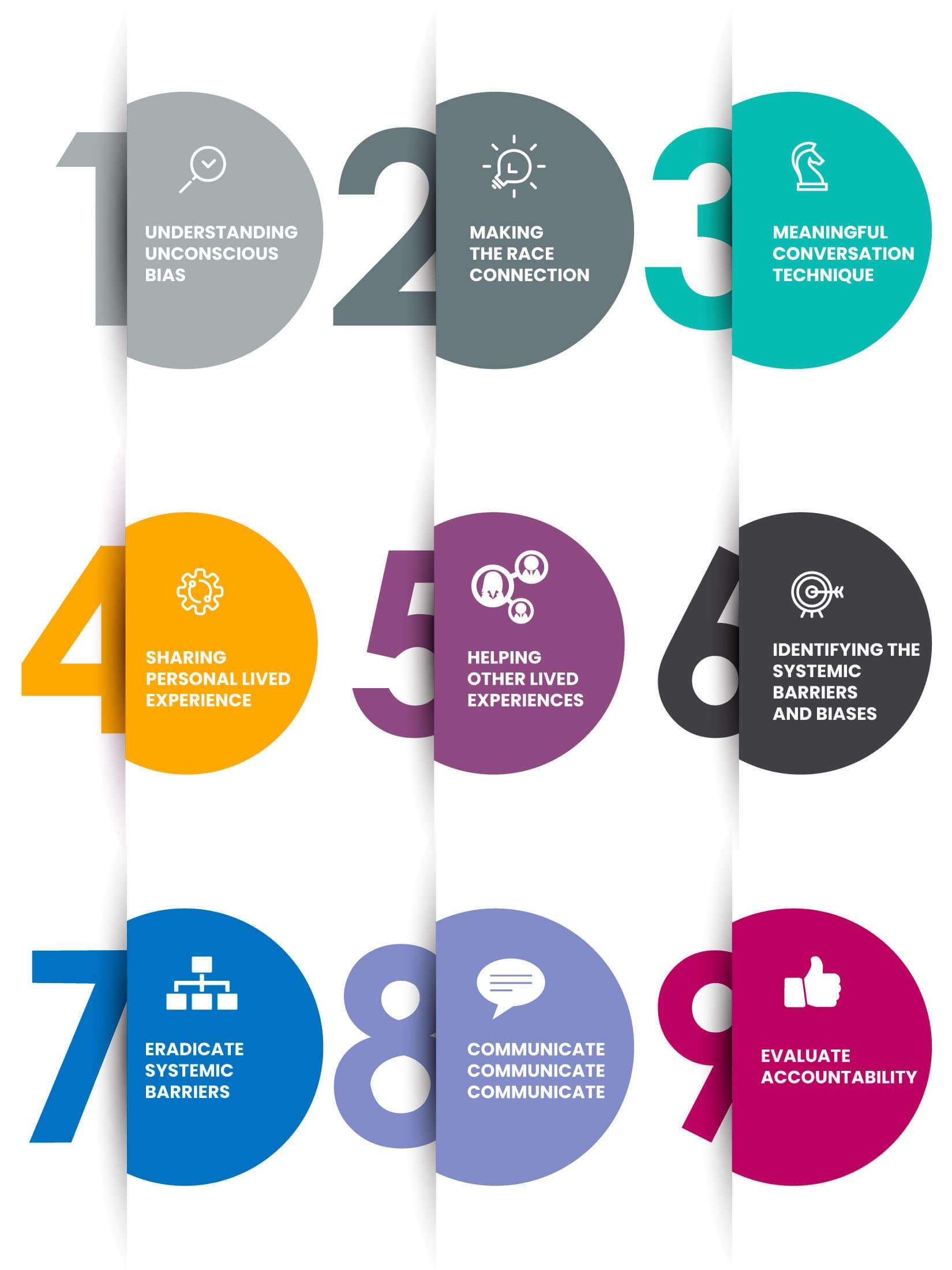
However, to ensure sustainability, Meaningful Conversations have to be followed with the Leadership identifying systemic barriers inside of their workplaces and within their span of control to eradicate. My firm, Alignment Strategies, follows this process to go beyond the Meaningful Conversations to make a systemic change:
If we are to find a solution that will bring our nation together, as an undivided people, we must begin to engage in a nationally sanctioned dialogue. This will bring about the realization that differences will always exist, yet we value what we have in common. The exploration of new possibilities for finding common ground will be key to building a better world and a more perfect union for all of us.
Being able to speaks our truths, while having a willingness to be challenged on our assumptions and beliefs, will bring about a more conducive workplace environment, where productivity increases, and the overall inclusive work experience will be positively heightened. Acceptance of diversity of thoughts, without demonizing, leads to enhanced belonging, greater productivity and increased profits. Recognition that differences matter and learning how to live with them, allows us to operate in business and in life, as an undivided nation.
