
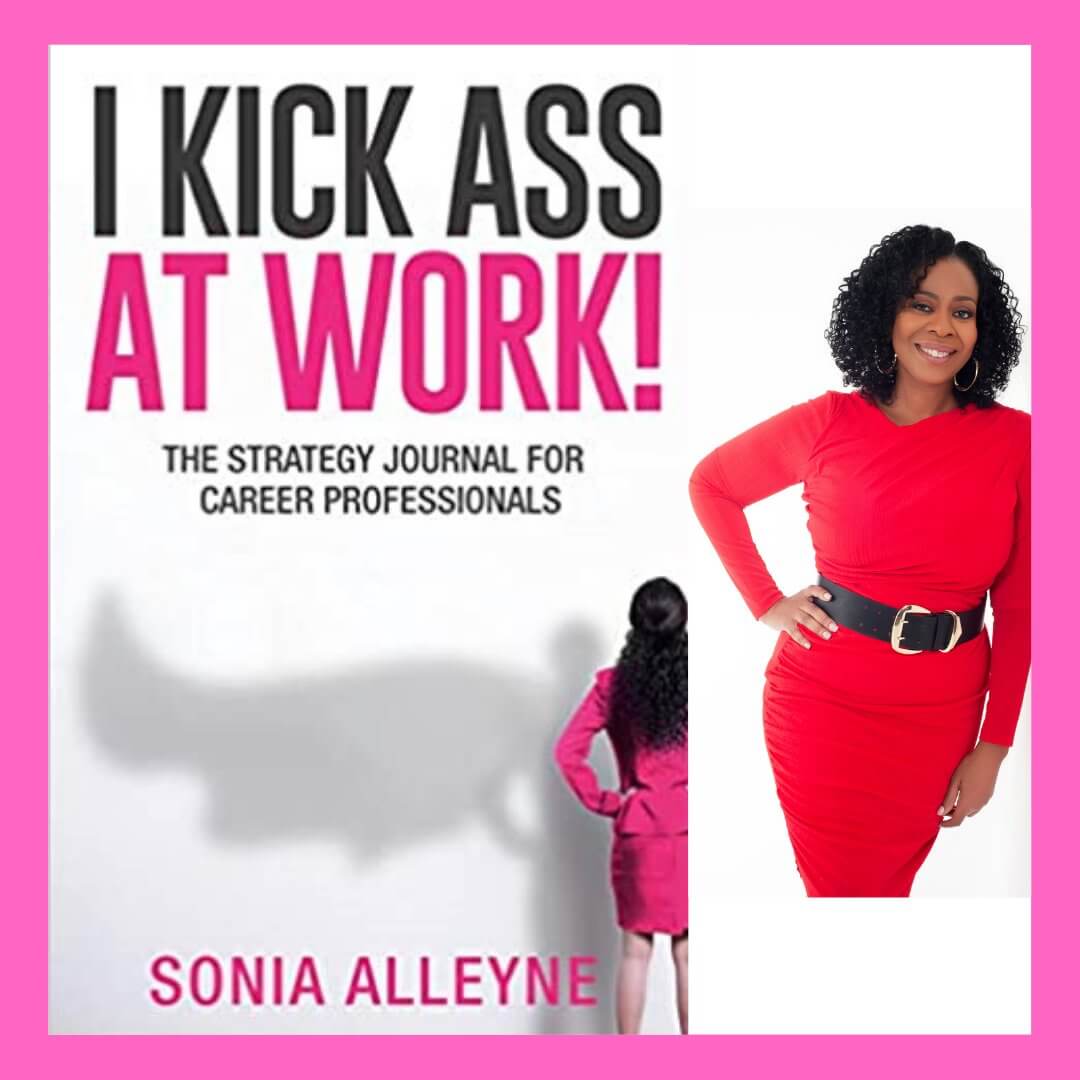
 Sonia Alleyne is a communications, marketing professional, and author of the book I Kick Ass at Work: The Strategy Journal for Career Professionals. It was developed to help women gain better insight and perspective about how they perform at their jobs. Alleyne has a career as an editor who has interviewed top business talent–Ursula Burns, Oprah Winfrey, Don Thompson, and Michael Lee Chin. The following is an excerpt of Dr. Weaver and Alleyne’s discussion on Workin It Out.
Weaver: Tell me a little bit about the title of your book.
Alleyne: I was in a dissatisfying job and I was beating myself up. Then I realized that when I interview of people who were becoming interns or folks who going to work with me, I always asked them “What story do you want to tell when you leave this job?”
I was frustrated with myself because I worked hard, but I didn’t have a story to tell. I decided to write everything down. Two and a half pages later, I literally said to myself, “I kick ass at work!” In one moment, I was beating myself up because I didn’t feel accomplished and in the next, I felt this great sense of pride and accomplishment because I did create something. I wanted it to be a provocative title because work can be that intense. I wanted people to really feel have a sense of ownership when they recognize how much of a contributor they are in the workplace.
It was revolutionary for me in that moment, and I could see how my energy changed. There was a confidence shift and I thought it would be important to create a tool that encouraged other women to do the same thing.
Weaver: So many people – many of them women – left their jobs during the pandemic. How does your book help women reconsider how they want to reenter the workforce or reposition themselves in the jobs that they have?
Alleyne: What was important about the pandemic was it was so disruptive. It forced us to reexamine how we were living our lives. Watching so many people perish around us and so many people get sick to the point of death made people say, “What am I really doing? Why am I doing this?” This book is to encourage people to journal and to look at where they are, where they want to go, and take the necessary steps to do that. You personally can change your career.
When you think about a lot of the discussions around workforce development and career development, we hear a lot of complaints. I want to be clear that I understand that all the isms–racism, sexism, ageism, the discrimination around sexual orientation–are real because they’re the fabric of the society that we live in. This is a tool to really look at what you are responsible for and what you can do to make a difference in your own career.
There is a unique situation for women and for workers in general. I’ve heard people say, “I don’t really want to ask for a raise because I know the company is doing poorly” or “I don’t know if this is a good time because of what’s going on in the company for me to do something else.”
Here are some questions to ask yourself: How are you developing as an individual and as a professional? Am I on the path for what I want to do later in life? Is this going to take me in the direction that I want to do to fulfill my personal dreams and goals?
Weaver: What is it about journaling that makes it an effective technique around thinking about your career?
Alleyne: I believe the process of writing is very cathartic and revealing. This is your time to write honestly about not just the challenges you face, but the things that are inspiring you and what you’ve accomplished. The whole purpose of writing things down is so that you can go back to reflect, review, and look at what needs to be changed.
Sometimes a lot of our actions are just automatic; this gives you a chance to look at what you’ve done and then see existing patterns. If they’re good patterns, then those are patterns that you want to enhance. If they’re negative or distracting patterns, then this is a chance for you to look at this differently.
Your emotions and thoughts are also actions because they are what is going to trigger you to behave in a certain way. Even though you might not say certain things out loud or you might be thinking or feeling some things. This is a place to put all of that down: Why does this person irritate me? Why am I jealous? Why am I angry? These aren’t bad emotions, but they give you an opportunity when you outline and look at them. Now I can change my outcome.
The very first thing I did was record some things that I noticed that I do often. Then you must reflect by asking yourself the questions like, why do I feel this way? Why am I always feeling like I’m underpaid and untitled? Then the last important part of that is the resolution because we don’t want to just get stuck with these emotions. You want to be able to solve them so that you can move to the next level. Resolution gives you a sense of accomplishment.
When you go through this process that you may recognize the need to get a coach or a therapist to help you with your struggles.
Weaver: What has been a response to your book?
Alleyne: Great so far. I’ve had people say that they’ve gotten promotions from doing this process. A good friend of mine says now her reviews are seamless because she’s clear about what she wants to talk about during her review. She’s clear about what she is doing and not doing so she can have a substantive discussion with her supervisor.
Weaver: Do you see a difference between how Baby Boomers versus the way Gen Z’s are dealing with their career?
Alleyne: Gen Z and younger professionals are clear about what does and doesn’t work for them. I think our generation was just about getting the work done. You weren’t supposed to complain. It was supposed to be hard and tough. You were just supposed to work through it.
I think both generations can learn from one another in a positive way. What I take from them is that if they’re uncomfortable in a situation, they’re going to remove themselves. They are not going to sit in punishment just for a paycheck.
My nephew and his friends created a network to discuss how they can manage their work situation and how to overcome certain challenges. They are resourceful in terms of trying to figure out how to make things better and more comfortable for themselves. I respect that a lot.
Weaver: What was one of your main takeaways from your interview with Oprah Winfrey and how she thought about her career?
Alleyne: There were two takeaways that I got from her that affected me for a long time. The first one she said, “you always know.” It’s a very simple piece of advice, but she says, no matter what you are doing, you always know and it’s important for you to listen to that inner piece of you.
The second piece of what she shared was those decisions that she made based on ego, always got her in trouble, but the decisions that she made based on an internal knowing were the ones that ended up being successful.
In all the years that I’ve interviewed people, I’ve never heard anyone say, “I followed my intuition and boy was that wrong.” Every friend who was on a successful journey has talked about how much their intuition and gut told them what to do or what not to do.
Weaver: What would you say to companies to keep their women as top talent?
Alleyne: I think that some companies are working to make changes. People must feel they are valued, their work matters, that their voice matters, and being compensated for the work they do is a huge thing for people.
My message is to find a way to make yourself valuable and to honor the value that you bring to an organization. Organizations have an obligation to make sure that they have strong, supportive work environments.
I do feel that it’s important for individuals to build relationships that make them safer and secure in an environment. Take time to explore and develop yourself as a person so that you can have a well-rounded experience at your company.
Finally, I tell people, make sure you take vacations. I’ve found that that people are most creative and most expressive in terms of creating good places for themselves when they detach.
