
Papal Bull, “Inter Caetera” Issued by Pope Alexander VI assigned Spain exclusive right to acquire territorial possessions and trade in all lands west of a demarcation line 100 leagues west of the Azores and Cape Verde Islands. The Bull stated that any land not inhabited by Christians was available to be “discovered,” claimed, and exploited by Christian rulers and declared that “the Catholic faith and the Christian religion be exalted and be everywhere increased and spread, that the health of souls be cared for and that barbarous nations be overthrown and brought to the faith itself.” This “Doctrine of Discovery” became the basis of all European claims in the Americas as well as the foundation for the United States’ western expansion.
The Bull Inter Caetera made headlines in the 1990s and in 2000, when many Catholics petitioned Pope John Paul II to formally revoke it and recognize the human rights of indigenous “non-Christian peoples.” As of 2020, it has not been revoked.
Explorer Alonzo Alvarez de Pineda claims Texas for Spain.
Ponce de Leon is granted a patent empowering him to colonize the island of Bimini and the island of Florida.
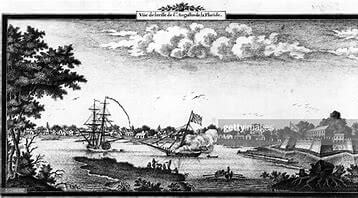 Saint Augustine brings the first European settlement to the United States, introducing Catholicism and the Spanish language in Florida.
Filipinos arrive at Morrow Bay, California. They are the first recorded Asian-descended people to arrive in the New World.
Spanish colonist hires Filipino laborers and sailors to manage ships and trade between Manila and Mexico.
New Mexico is settled by the Spanish—becoming the largest and earliest Spanish settlement in the Southwest.
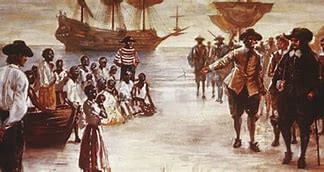
Slavery in America begins with arrival of African slaves to the North American colony of Jamestown, Virginia. They aid the production of lucrative crops as tobacco.
Filipino workers known as “Manilamen” jump off a Spanish galleon and establish a settlement in St Malo, LA. St. Malo becomes a shrimping and fishing village. They are regarded as the first Asians settlers in the United States.
MA becomes the first colony to recognize slavery.
Pueblo Indians throughout New Mexico revolt and drive out Spanish to El Paso.
The first permanent Spanish settlement in Texas, San Francisco de los Tejas, near the Nuecces River is established.
School for African-Americans opened in Philadelphia.
First Abolition society organized. African-Americans enlisted in Continental Army.
The Declaration of Independence establishes the United States as a country apart from British sovereignty.
Four Chinese sailors land in Baltimore, Maryland on August 9, 1785 aboard the Pallas, owned by John O’Donnell, the first American ship to sail goods from Guangzhou in Southern China to Baltimore. Trade opens between Baltimore and Far East.
Following the American Independence from the British, Asian Indian immigrants begin entering the U.S. as maritime workers.
Benjamin Banneker, the African American self-taught mathematician and almanac-maker, helped survey Washington DC.
Richard Allen formed Philadelphia’s Bethel African Methodist Episcopal Church in response to racial discrimination against African-Americans by officials at the St George’s Methodist Episcopal Church.
African American Eli Whitney, invents the cotton gin which separates the seeds from cotton.
Eli Whitney figures out how to manufacture muskets by machine making parts interchangeable. As a manufacturer of muskets that Whitney becomes rich.